
Not Illegal. Not Secure. Just Stuck.
The silent crisis facing international students and temporary workers

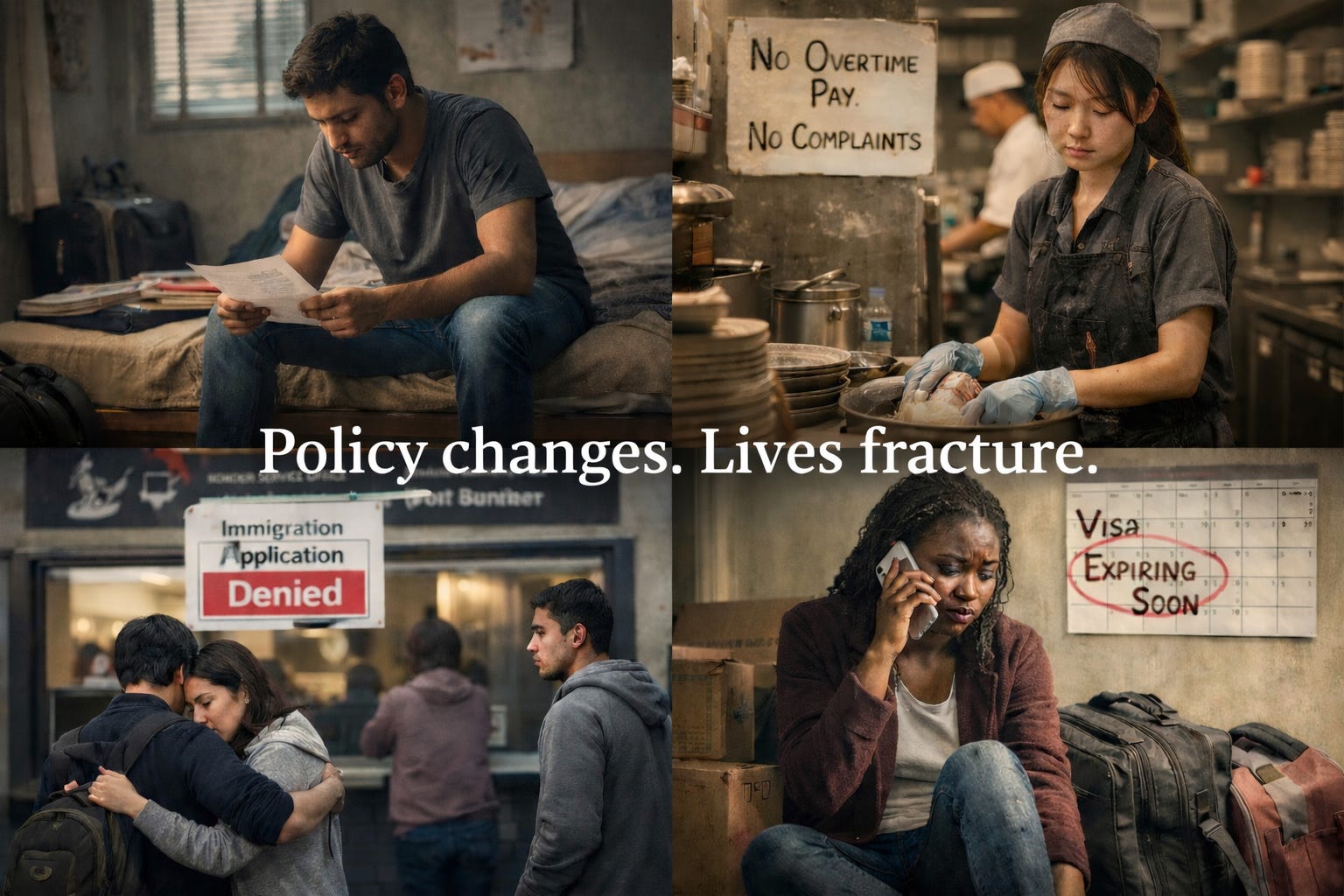
Across Canada—and similarly in the United States—immigration is often discussed in technical terms: caps, quotas, points, targets. What remains largely invisible is the lived reality created by prolonged temporary status for international students and temporary workers who fully comply with the system yet remain structurally insecure.
Over the past five years, this population expanded rapidly in number while shrinking in certainty.
They are not undocumented.
They are not outside the system.
They are fully inside it—and unable to move forward.
Permanent Temporariness
Temporary visas were designed as bridges—study permits, post-graduation work permits, employer-specific authorizations. In practice, they have become holding zones.
International students commit years of their lives and tens of thousands of dollars upfront, often funded through family debt or lifetime savings. Temporary workers relocate based on officially declared labour shortages that imply continuity. Both groups make irreversible decisions assuming that compliance and contribution will lead to stability.
Instead, they encounter policy volatility:
Eligibility thresholds change after enrollment
Points systems are recalibrated mid-pathway
Occupation lists narrow without transition buffers
Caps appear retroactively
Lives planned under one framework are assessed under another.
This is not a failure of compliance.
It is a failure of continuity.
Work Without Power—and Exploitation by Design
International students and temporary workers enter the labour market with limited leverage. Work hours are capped. Job mobility is restricted. In many cases, legal status depends on a single employer.
When status is tied to employment:
Reporting abuse becomes risky
Wage negotiation is structurally discouraged
Job loss can trigger legal precarity within weeks
Within this imbalance, exploitation becomes easier to normalize. Many report being paid below legal or agreed wages, working unpaid or excessive hours, or being denied statutory holiday and vacation pay. Some face unsafe conditions or coercive pressure—often reinforced by reminders that they are temporary and replaceable.
Labour protections exist on paper. In practice, the people most dependent on them are often least able to enforce them. Exploitation on Canadian soil—through unpaid labour, withheld entitlements, or coercive dependency—stands in direct contradiction to the standards Canada publicly claims to uphold.
Economic Contribution: The Numbers Behind the Narrative
Despite their insecurity, international students have become a major economic pillar.
In 2022, international students spent approximately CAD $37.3 billion in Canada, contributing $30.9 billion to GDP and supporting roughly 361,000 jobs. From 2019 to 2023, total spending is estimated at CAD $150–165 billion across tuition, housing, transportation, and daily consumption. International education now accounts for more than 20% of Canada’s service exports.
Canada benefits enormously from this contribution—while offering many students no durable future.
Rising Costs, Fragile Margins
The financial burden is front-loaded and unforgiving. International tuition commonly runs two to four times domestic rates, often CAD $35,000–$45,000 per year, excluding living costs. Since 2020, average rents in major cities rose 25–40%, while student and temporary-worker wages did not keep pace.
Costs are fixed.
Income is conditional.
The margin for error is thin—and shrinking.
Recent Policy Decisions—and a Sharp Reversal
After years of rapid expansion, the direction has reversed.
Canada reached a peak of more than 900,000 international students in 2023. Following federal study-permit caps, new approvals fell by roughly 40–45% in 2024–2025, with further reductions planned through 2026. The combined temporary-resident population—students and workers—peaked at over 1.5 million; federal projections now point to a net decline of several hundred thousand as permits expire and pathways narrow.
The shift is not gradual.
It is corrective—and rapid.
And it is felt most acutely by those already inside the system.
Additional changes compounded uncertainty. Post-Graduation Work Permit rules were updated from late 2024 onward, introducing new language and field-of-study conditions. Work-hour rules were adjusted mid-pathway. At the provincial level, established programs were restructured or closed after commitments had already been made.
Arrival, it turns out, no longer guarantees continuity.
Pressure From Home, Conditional Belonging
For many, studying or working abroad is a collective family investment. When promised pathways narrow, silence replaces honesty. Anxiety is carried privately—to protect families from worry, disappointment, or shame.
As housing shortages and wage stagnation intensify, migrants become symbols of systemic failures they did not create. Belonging turns conditional—tolerated rather than welcomed, questioned rather than understood.
The Cost We Don’t Measure
Prolonged uncertainty delays careers, families, home ownership, and belonging. People live with permanent contingency plans—mentally packed bags, if not physical ones.
This condition does not produce integration.
It produces hesitation.
When people cannot see a future, they stop investing fully in the present.
Beyond Compliance, Toward Consequence
This is not an argument for open borders or automatic status. It is an observation grounded in consequence.
Systems that prolong temporary status without clear, stable pathways do not remain neutral. They shape behaviour, distort incentives, and determine who can plan—and who must endure.
The question is no longer simply how many people arrive or leave.
It is what kind of lives are being produced in between.
Not illegal.
Not secure.
Just stuck.
Author’s Note
This essay reflects observed patterns across Canada and the United States between 2020 and 2025. While policies differ by jurisdiction, the lived experience of prolonged uncertainty among international students and temporary workers remains strikingly consistent.
Data cited reflects publicly available government and institutional sources. Figures are approximate and intended to illustrate broader trends.
References & Resources
Government of Canada — Economic Impact of International Students in Canada (2022)
Statistics Canada — Rental market and labour indicators (2020–2024)
Immigration, Refugees and Citizenship Canada — Study-permit caps; PGWP updates (2024–2026)
Canadian Bureau for International Education — International student statistics
World Education Services — International education data & policy analysis
OECD — Household debt and cost-of-living indicators


Mentally packed bags…I identify with that. Leaving the convent was kind of like leaving a foreign country.
The abuse that can happen when everything hinges on one anything, person, job, whatever…it is so sad. Being alone without a safety net is a commentary on our fractured society globally.
I can identify with this. Came to the US many years ago as an international student. This became home. Now everything is uncertain especially if you are an immigrant. My home doesn’t feel like home anymore. Just subbed. Hope you read my work and sub back.